HOW TO USE IT
About the startup budget template
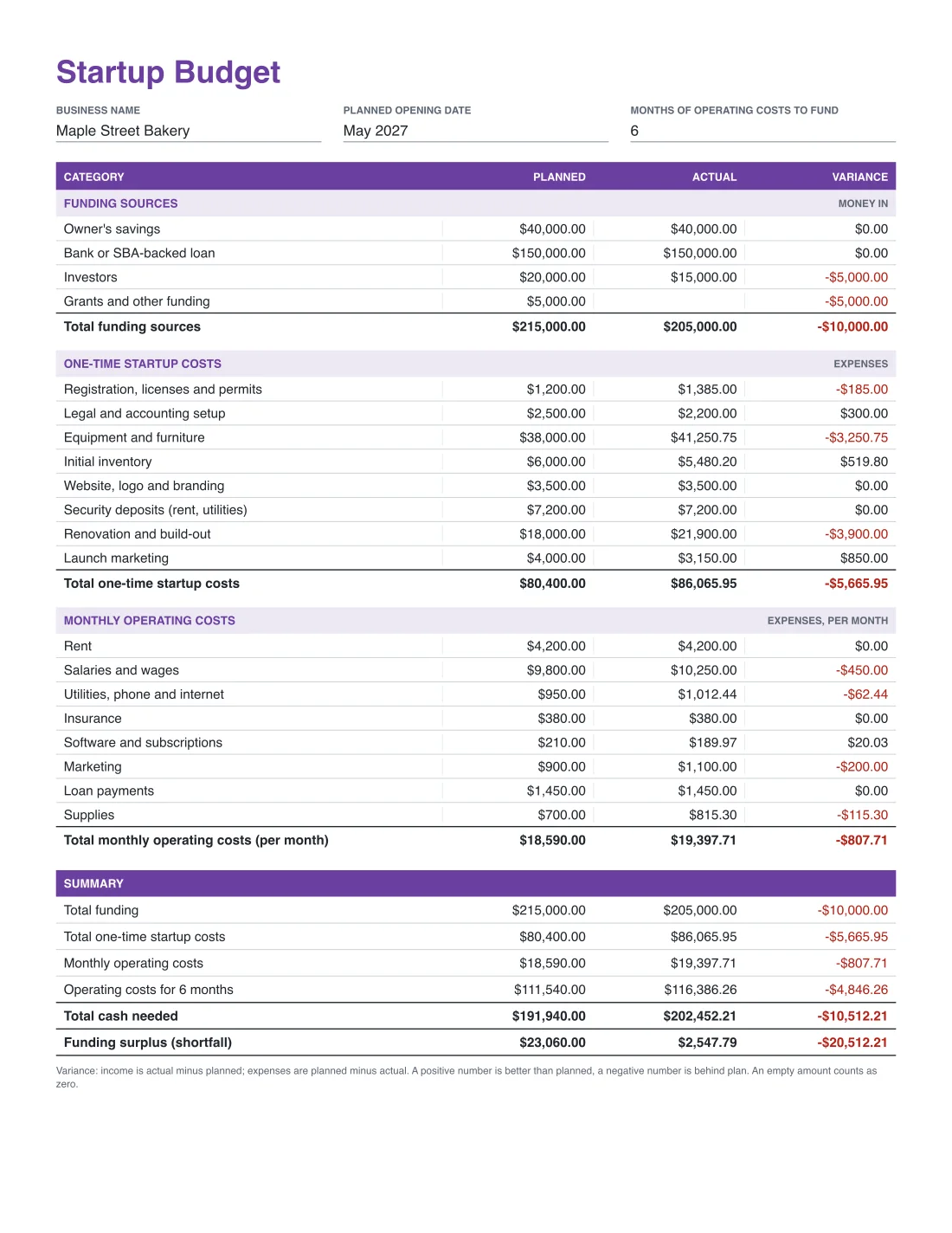
A startup budget answers the first money question of a new business: how much cash do I need before the business pays for itself? It adds the one-time costs of opening (registration, equipment, inventory, a website, deposits, build-out) to the regular monthly costs you will pay while sales are still growing, and compares the total with the money you have from savings, loans, investors and grants.
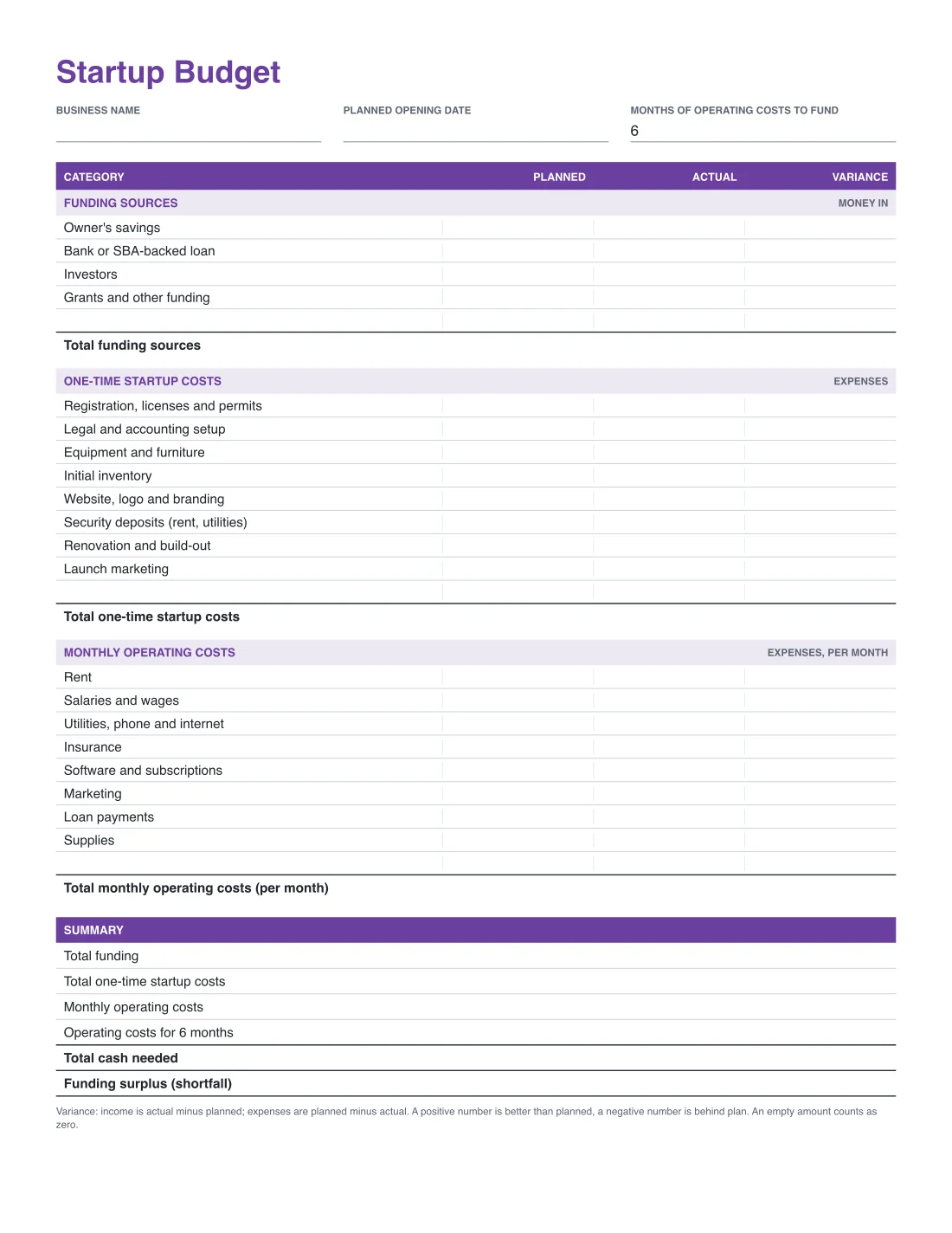
The U.S. Small Business Administration suggests separating one-time expenses from monthly expenses when you calculate startup costs. This template does exactly that. Choose how many months of operating costs you want funded (6 is a common starting point), and the summary multiplies your monthly costs by that number, adds the one-time costs and shows the total cash needed and the surplus or shortfall.
Planned and actual columns let you keep using the same sheet after launch: record what equipment, permits and the build-out really cost, and the variance shows where your estimates were off, which is useful the next time you ask a lender for money.
How to print your startup budget template
1. Estimate one-time startup costs
List everything you pay once before or at opening. Permits and licenses usually have published fees; for equipment, build-out and inventory, get quotes from vendors. Add a buffer for surprises, because first estimates tend to be low.
2. Estimate monthly operating costs and choose the months
List rent, payroll, utilities, insurance, software, marketing, loan payments and supplies for a typical month. Then set how many months of costs you want covered before the business is expected to pay its own bills.
3. Add your funding and close the gap
Enter savings, loans, investors and grants. If the summary shows a shortfall, cut or delay costs, raise more funding, or plan for more months. Download the Excel file to keep the plan live while you collect quotes.
Common startup costs to budget for
- Registration, licenses and permits for your business type, city and state.
- Legal and accounting setup: forming the business, contracts, and setting up bookkeeping and payroll.
- Equipment, furniture, computers and vehicles, plus installation and delivery.
- Initial inventory and supplies, and packaging if you sell products.
- Website, logo, signage and printed marketing materials, and the launch campaign.
- Security deposits for rent and utilities, and renovation or build-out of the space.
- Insurance, which is often required before you sign a lease or start work.
How many months of operating costs should you fund?
There is no single right number. A business that will have paying customers on day one, such as a contractor with signed jobs, may need only a couple of months. A restaurant, a retail store or a business that sells to large companies with long payment terms can take much longer to cover its costs, so it needs more months funded. Six months is a sensible place to start; change the number in the header and the totals follow.
Monthly costs include what you owe even when sales are slow: rent, insurance, software, loan payments and the salaries you have committed to. If you plan to pay yourself, add your own pay as a monthly line, because the money you need to live on is part of the cash the business must cover.
Startup costs and taxes
IRS Publication 583 explains that business start-up costs are expenses you incur before you begin operating, and that they are generally capital expenses. According to the publication, you can elect to deduct up to $5,000 of business start-up costs and up to $5,000 of organizational costs, each deduction is reduced by the amount the costs exceed $50,000, and the remaining costs are amortized. Equipment and other property you will use for years is usually recovered through depreciation instead.
Keep receipts and invoices for every startup cost, and ask a tax professional how the rules apply to your business; this budget is a planning tool, not tax advice.
Use the startup budget in Excel, Google Sheets or Numbers
- Excel: open the .xlsx file directly. Totals, subtotals and variance are live formulas, so they update as soon as you change an amount.
- Google Sheets: in Google Drive click New > File upload, then open the file with Google Sheets, or use File > Import in a blank spreadsheet. The formulas carry over.
- Numbers on Mac, iPhone and iPad: open the file and Numbers converts it, formulas included.
- Insert rows inside a group (not below its subtotal) and the SUM formulas grow with them. Type amounts as plain numbers; the dollar format is applied for you.
- The months to fund are a cell in the header: change the number and the operating costs, the total cash needed and the funding surplus or shortfall recalculate.
From startup budget to business plan
Lenders and investors expect a business plan with financial projections, and the SBA recommends including startup costs and how you will fund them. The totals from this template feed straight into that section: the cash you need, where it comes from and how long it lasts. Many lenders also ask owners for a personal financial statement, so prepare both at the same time.